
Canadian employers may seek to employ foreign nationals for a number of different reasons. Perhaps they are unable to find a Canadian with the necessary skills to fill the position, or perhaps they wish to assist a foreign national who is seeking permanent residence in Canada. No matter what the reason, there are a range of hiring options available for Canadian employers to hire foreign nationals.
All foreign nationals require the appropriate authorization to legally work in Canada. There are a few options for securing the authorization to work: obtaining a work permit, qualifying for a work permit exemption, or becoming a Canadian permanent resident. Each of these options has a different set of eligibility requirements and application procedures.
In certain circumstances an employer may be required to obtain a Labour Market Impact Assessment (LMIA) to support a work permit application, or to supply a foreign national with an official job offer to support a permanent residency application. Read below to learn more about the various pathways and procedures for hiring foreign nationals to work in Canada.
- Temporary Foreign Worker Program: The Temporary Foreign Worker Program (TFWP) encompasses an array of smaller immigration programs enabling foreign workers to engage in temporary employment in Canada. All programs contained within TFWP require that employers have received a positive Labour Market Impact Assessment (LMIA) before the foreign national may apply for a work permit.
- International Mobility Program: The International Mobility Program (IMP) refers to a collection of smaller programs enabling foreign nationals to engage in temporary employment in Canada. In contrast to the TFWP, all programs contained within IMP do not require a Labour Market Impact Assessment (LMIA). IMP encompasses a collection of LMIA-exempt programs as well as a range of programs enabling foreign nationals to obtain open work permits.
- Economic Immigration Programs: Once a foreign national obtains Canadian permanent resident status, they become legally authorized to live and work anywhere in Canada. In some cases, it may be possible for a Canadian employer to assist a foreign national with obtaining permanent residency. This may be possible by providing an official job offer through one of the following permanent residency pathways:
- Professional and Skilled Workers
- Provincial Nominee Programs (PNPs)
- Atlantic Immigration Pilot Program (AIPP)
In most cases, official job offers submitted in support of a permanent residency application must be accompanied by a Labour Market Impact Assessment (LMIA). However, through the Global Skills Strategy, it is sometimes possible to expedite the processing of LMIA applications submitted in support of a permanent residency application.
LMIA (LABOUR MARKET IMPACT ASSESSMENT)
Labour Market Impact Assessment (LMIA) is a document issued by Employment and Social Development Canada (ESDC) assessing the impact of hiring a foreign national in Canada. A positive LMIA indicates that there is no Canadian citizen or permanent resident to fill a position, therefore enabling an employer to hire a foreign national. A negative LMIA indicates that a position should be filled by a Canadian citizen or permanent resident.
An employer may submit an application for an LMIA as early as 6-months prior to the intended start date for the position. LMIA application procedures vary depending on the wage of the person being hired. Employers should consult the median hourly wages of their province or territory in order to determine whether their position is considered high-wage or low-wage, as low-wage positions will require the employer to meet additional criteria. There are specialized streams for employers wishing to obtain LMIAs for certain areas of employment. These include:
- Hiring In-Home Caregivers
- Hiring Agricultural Workers
- Hiring Foreign Academics
- Hiring within the province of Quebec
LMIA Application Requirements
LMIA applications are submitted in hard copy, by mail, to the appropriate Service Canada Processing Centre. Applications must include evidence that the following criteria have been met:
- Processing Fee: All applications for LMIAs include a $1000 CAD processing fee which will not be refunded even if the result is negative. Certain applicants under the LMIAs for in-home caregivers may be exempt from this fee.
- Business Legitimacy Documents: Documents proving that the employer’s status as a legitimate Canadian business.
- Transition Plan: Employers must submit a plan for how they intend to address the need to hire foreign nationals. Eventually, employers are expected to hire Canadian citizens and permanent residents rather than TFWs.
- Recruitment Efforts: Employers must submit evidence that they made substantial efforts to recruit Canadian citizens and permanent residents to fill the position prior to hiring a TFW.
- Wages: Applications must include information regarding the TFWs wages. This will differentiate the high-wage positions from low-wage positions and ensure that TFWs are paid the same amount for labour as their Canadian equals.
- Workplace Safety: TFWs are entitled to the same standards of workplace health and safety as Canadians in the same position. For this reason, employers must provide evidence that TFWs will be covered by insurance which is at minimum equivalent to the health coverage offered by the province or territory where the business is located.
Low-Wage Workers
Employers submitting LMIA applications for low-wage positions, must also address the following three requirements:
- Cap on TFWs: If an employer has previously hired TFWs they
- Transportation: Employers must provide low-wage workers with adequate transportation to and from Canada. This transportation is provided at the employer’s expense.
- Housing: Low-wage workers must be provided with adequate housing for the duration of their employment in Canada.
What Happens After LMIA is Approved
After an LMIA application has been processed, employers will be issued a decision. If the employer is issued a positive LMIA, they can proceed with hiring a foreign national. If a negative LMIA is issued then unfortunately the employer is not approved to hire a foreign national.
Positive LMIAs are valid for 6 months from the date of issue. After receiving a positive LMIA, the employer must notify the foreign national so that they can apply for their work permit or permanent residence. In certain conditions, employers may apply to have their LMIA application processed in 10 days. To qualify for expedited processing, an employer must be located outside of Quebec and meet one of the following requirements:
- Highest wage positions: top 10% of wages earned by Canadians in the province/territory of the job
- Skilled Trades: paid at least the median provincial/territorial wage for the position.
- Short-Term positions: 120 days or less
- Express Entry: the LMIA is to assist an Express Entry candidate
Median Hourly Wages by Province or Territory
If an employer is hiring a TFW to be paid at or above the median hourly wage for their province or territory then they must go through the high-wage workers stream for LMIAs. If an employer is hiring a TFW to be paid below the median hourly wage then they must go through the low-wage workers stream.
SINP EMPLOYERS
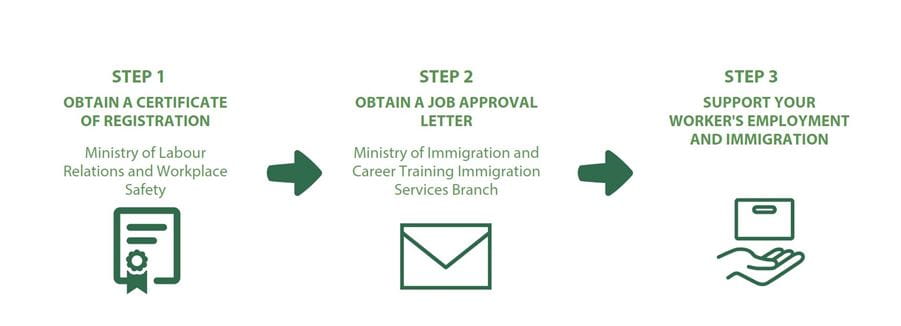
Link to obtain the image above: https://www.saskatchewan.ca/residents/moving-to-saskatchewan/hire-a-foreign-worker/recruit-and-hire-workers-with-sinp/hiring-workers-for-permanent-jobs
Certificate of Registration- Eligibility
- be a permanent resident or a citizen of Canada;
- provide a work location for a foreign worker zoned for commercial operations;
- actively operate the business as the employer for no less than 12 months;
- have demonstrated compliance with employment laws by already having employees (non-family members) for a reasonable period given your operation (normally, 12 months); and
- provide any documentation requested by an officer to support your application, including:
- financial statements;
- business plans;
- incorporation documents;
- Canada Revenue Agency documents;
- business licence;
- lease/rental agreements;
- business employee attendance and payroll records;
- business contracts; and
- contractor permits.
Job Approval Letter
To be eligible for approval, all online applications for a SINP JAL must:
- Be for a place of work that is within the geographic boundaries of Saskatchewan.
- Your business location must be zone as 100 per cent commercial, or a minimum of 50 per cent commercial use and have regular operating hours, public access, and a separate entrance and internal separation from attached residences.
- Be for a position that demonstrates employer-employee relationship. Independent contractors, temporary agency workers, or business owners (e.g., shareholder, equity holder etc.) and their immediate family (spouse and children) are not eligible for a SINP JAL.
- Have an Active Certificate of Registration (COR). A COR that requires renewal or is under assessment for renewal will not be considered Active. If the COR is not active when the assessment begins on a Job Approval Form, it will result in the JAF being found ineligible.
- Be submitted from a SINP account that has contact information from an email associated with a custom employer domain name or, if no employer domain name exists, a Canadian telecom provider. Emails from providers such as Gmail, Yahoo, Hotmail or Outlook cannot be used for integrity reasons. The Authorization email on your account must be the employer email. The Correspondence email on your account must be the employer email; or the employer email AND the immigration recruiter email. If you are using a recruiter, the email address listed on your account for the recruiter must be listed on the Licensed Recruiter list.
- Be for an occupation that is eligible for recruitment through the SINP. Select high-skilled, semi-skilled, and low-skilled positions are eligible for the SINP (see the section: Eligible SINP Occupations and Determining the National Occupation Code).
- Be for a full-time (minimum of 30 hours/week) and permanent job (no end date or at least two years in length). The position must be for:
- an existing employee,
- an existing vacancy, which is a position recently vacated by a full-time employee,
- a position that will be vacated within 6 months by an existing full-time employee; or
- a position that is being filled through full-time contract work.
- Demonstrate the business capacity to hire and support the candidate’s full-time employment, as per the Job Offer, throughout the immigration process. You may be asked to show documentation to demonstrate that the business is stable (in operation for a year of longer) and has the financial ability to support the candidate’s employment, such as income tax returns and payroll remittance forms.
- The wage must be fair and equitable to the wage paid to Canadians and permanent residents. This is demonstrated by using the benchmark or providing proof of wages paid to Canadians and permanent residents (pay stubs for current employees; cannot be below the low wage for that region). The standard benchmark used by the SINP for wages paid to foreign workers to ensure ethical recruitment is the National Job Bank’s Regional Median Wage for that occupation in Saskatchewan. The six regions include:
- Northern Region
- Prince Albert Region
- Regina–Moose Mountain Region
- Saskatoon–Biggar Region
- Swift Current–Moose Jaw Region
- Yorkton–Melville Region
- Include the current hours of operation and shifts per day if the position requires shift work.
- State whether the position requires licensure or professional certification. The worker will need to provide proof of eligibility in their immigration application.
- Include a copy of the worker’s work permit if they are currently working for the employer in Saskatchewan. Note: some SINP categories require that the worker has a Labour Market Impact Assessment (LMIA) supported work permit.
- Identify any equipment required to do the job is currently available for the candidate to use.
- In the case of Truck Drivers (NOC 73300), only heavy vehicles registered, licensed and insured in Saskatchewan will be considered. Only vehicles registered to the organization applying for the JAL will be considered during the assessment. Companies will also be required to provide copies of lease agreements (if applicable), current carrier profile, and current National Safety Code (NSC) certificate with their applications. Only those companies with a current NSC certificate with a Satisfactory Audited or Satisfactory Unaudited rating will be considered.
- Please note that a maximum of two truck drivers per truck will be approved per registered qualifying vehicle.
- Position requested must not conflict with existing collective bargaining agreements or labour disputes.
- Include a Job Offer Letter (generic if employee not identified), which includes ALL of the following information:
- includes the contact’s name, phone number, e-mail address and company mailing address;
- indicates that the position is a permanent, full time (minimum 30 hours/week) skilled position(s) in Saskatchewan (non-seasonal);
- indicates the wage (i.e. rate of pay) for the position being offered;
- indicates the job title, detailed duties and responsibilities of the position being offered;
- indicates the physical address where the candidate will be working; and
- if you are applying under NOC 73300 the Job Offer Letter must indicate the type of vehicle to be driven – power units and semi-trailers, and trucks which have a trailer(s) or vehicle(s) in tow where the gross weight of the towed unit(s) exceeds 4,600 kg OR other type of transport truck.
- indicate rate of overtime pay. If specific information is not provided related to the position, the Job Offer letter must state the following as per provincial legislation: “Overtime pay will be paid at the rate of at least 1.5 times the hourly wage rate, after 8 hours a day and 40 hours a week.” If the position falls under a Modified Work Arrangement (MWA), please indicate the MWA conditions on the Job Offer Letter.
- indicate vacation entitlements. If specific information is not provided related to the position, the Job Offer letter must state the following as per provincial legislation: “Employees receive a minimum of three weeks of vacation after each year of employment. Employees who complete 10 years of work with the same employer receive a minimum of four weeks of vacation. All eligible full-time, part-time, casual, temporary, and seasonal employees (including those who have not worked a full year with the same employer) receive vacation pay so they are paid during this time off work.”
Source: https://www.saskatchewan.ca/residents/moving-to-saskatchewan/hire-a-foreign-worker